

European consumer loans offer professional investors access to returns generated primarily by interest and principal payments from private borrowers. Short maturities and a highly granular portfolio can reduce the immediate sensitivity to movements in government bond yields and credit spreads. Credit quality, however, remains central to the investment case.

By Claus Tumbrägel, Member of the Management Board and Fund Manager, nordIX AG
+49 40 309 9776-0
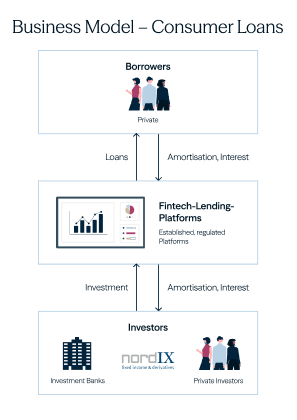
Fixed-income markets have become more attractive as yields have moved higher. At the same time, recent years have shown how strongly traditional bond portfolios can react when government yields and credit spreads move within a short period. Portfolios with longer duration are particularly exposed, as changes in market rates translate directly into valuation effects. European consumer credit has different economic drivers. Returns are generated from the interest paid by private borrowers, while principal is repaid continuously and can be reinvested into new loans at prevailing lending conditions. The portfolio therefore responds differently to changes in market rates than a long-dated government or corporate bond whose coupon and maturity were fixed at issuance.
Granularity limits the impact of individual defaults
A professional consumer-credit portfolio combines many relatively small exposures. In the nordIX European Consumer Credit Fund, the average loan size is approximately EUR 1,300 and the portfolio comprises around 200,000 individual loans. The impact of a single borrower default is therefore limited. Diversification extends beyond the number of borrowers. The fund works with credit platforms across a broad range of European markets and covers different customer groups and areas of consumer finance. The current portfolio is spread across countries including Spain, Germany, Sweden, Lithuania, the United Kingdom and several other European markets. The structure also provides the fund manager with a broad data set. Payment behaviour, arrears and default rates can be monitored across different parts of the portfolio. The central question is whether the interest earned adequately compensates for expected credit losses. A high nominal lending rate alone does not make a loan attractive.
Short maturities change interest-rate exposure
The weighted average remaining maturity of the underlying loans is around 1.5 years. Regular repayments continuously release capital for new investments. When lending conditions change, a short-duration portfolio can therefore adjust more quickly than a portfolio of long-dated fixed-rate securities. This distinction has remained relevant throughout 2026, with government bond yields and changing expectations for monetary policy repeatedly affecting traditional fixed-income markets.
As of 30 October 2026, assets under management in the European Consumer Credit Fund stood at EUR 311.48 million. Share class C had returned 5.50 per cent since the beginning of the year and 6.65 per cent over the previous twelve months. Its cumulative three-year return was 20.00 per cent. Historical volatility stood at 0.28 per cent over one year and 0.43 per cent over three years. These figures describe historical performance and do not indicate future returns. They do, however, illustrate where the main risks of the strategy arise. Daily movements in long-term interest rates have a comparatively limited direct effect. The payment capacity of borrowers and the quality of the underlying loan portfolios matter considerably more.
Credit analysis remains essential
Consumer credit requires its own due-diligence process. Before adding a new platform, nordIX reviews its lending standards and the historical performance of its loan portfolios. Arrears and realised default rates are monitored after investments have been made and compared with the assumptions applied when the loans were acquired. Platform and servicing structures also matter. Consumer loans are not exchange-traded securities, and investors need to consider their liquidity requirements accordingly. The strategy is therefore better understood as a complementary source of fixed income returns than as a direct substitute for liquid government or corporate bonds.
A CHF implementation for Swiss investors
For Swiss professional investors, currency is another practical consideration. Since April 2026, the European Consumer Credit Fund has offered a CHF-denominated share class. The underlying investment approach remains unchanged, while the share class allows the strategy to be incorporated into CHF-based mandates and reporting structures. This can be relevant for independent asset managers, family offices and other professional investors that use the Swiss franc as their reference currency.
European consumer credit adds a source of return whose behaviour differs from that of conventional bond markets. Short maturities reduce the immediate exposure to movements in long-term yields, while the granular portfolio structure limits the influence of individual borrowers. Credit quality realised defaults and the robustness of the platforms remain the decisive factors. For professional investors, these characteristics can make consumer credit a useful complement to traditional fixed-income allocations.
Further information: nordIX European Consumer Credit Fund, https://nord-ix.com/en/nordix-european-consumer-credit-fonds